Category: Calligraphy Paper

  • Proper Storage and “Laying” of Calligraphy Paper

    Proper Storage and “Laying” of Calligraphy Paper

    Calligraphy paper plays a crucial role among the Four Treasures of the Study. It offers a wide range of textures and appearances depending on its thickness and production method. To preserve the quality of calligraphy paper and make the most of it for creating art, it’s important to follow proper storage practices.

    What is the correct way to store calligraphy paper?

    When it comes to the storage of calligraphy paper, it’s essential to be particularly cautious about direct sunlight and humidity.

    Recommended Storage Location

    Choose a place where direct sunlight does not shine, there is good ventilation, and humidity is minimal. Inside a paulownia box or on top of a chest of drawers is often considered suitable.

    Recommended Storage Methods

    Wrapping the calligraphy paper in newspaper or Japanese paper allows the paper to breathe and provides protection against direct sunlight. Placing a wooden lattice (sudoko) under the calligraphy paper for better ventilation and using moisture-absorbing agents or desiccants for humidity control can be effective. Additionally, adding moth repellent (such as mothballs for clothing) can help prevent insect damage. Be cautious about sealing the paper in materials like vinyl, as it can prevent the paper from breathing and may lead to stains.

    What Does it Mean to “Lay” the Paper?

    There is a saying that paper is generally better when it has aged for a few years rather than being freshly made. The ideal period for aging can vary, with some calligraphers suggesting a period of 10 years. It ultimately depends on the style of the artwork you wish to create and your personal preferences, so feel free to experiment to find the aging period that suits your taste.

    Benefits of Laying the Paper
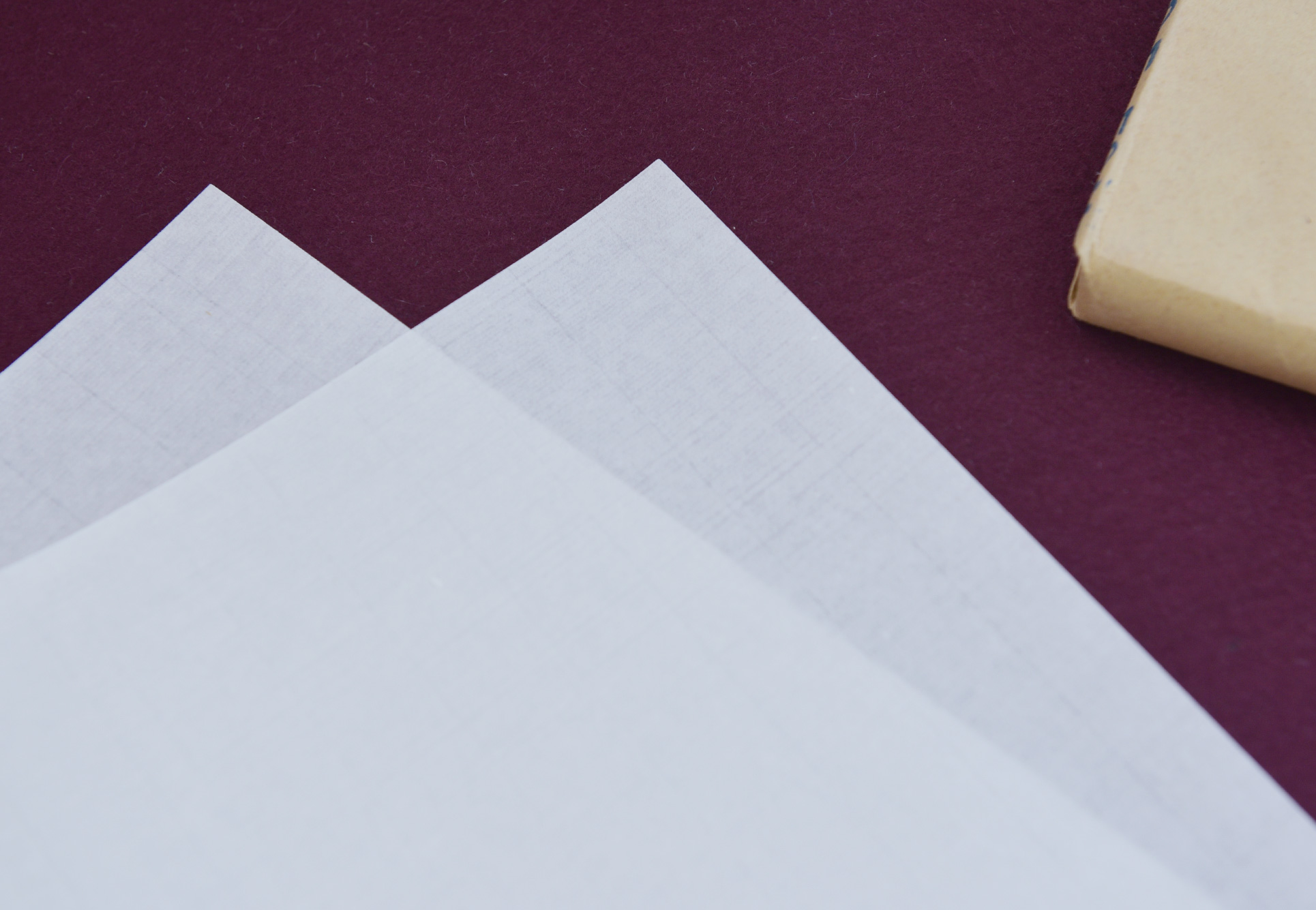
    Aging paper allows excess moisture to escape and tightens the paper fibers, resulting in several benefits:

    ①Ink permeates the paper adequately, reducing bleeding.
    ②Ink color becomes more beautiful.
    ③Distressed effects (such as fading or wear) appear more attractive.
    ④The brush separates from the paper more smoothly, making it easier to write.

    Paper breathes in humidity and releases it, effectively eliminating gluey residues and moisture. Paper in this dried state is referred to as “aged paper.” Aged paper not only improves ink adhesion and color but also enhances the appearance of effects like bleeding and distress. While aging paper may sometimes lead to slight yellowing or “star” stains, with proper storage, these characteristics can be valued assets.

    It’s important to note that paper containing anti-bleeding agents or dyes (such as decorative paper, processed paper, and machine-made Japanese paper) does not benefit from aging. In fact, these papers can become rigid and prone to breakage during long-term storage.


    Paper Can Catch a “Cold” Too!?

    On the flip side, even if paper is adequately aged, incorrect storage methods can lead to issues like paper appearing white and speckled when ink is applied, a phenomenon akin to “paper catching a cold.” Depending on the aging method, it can even degrade paper quality. Therefore, exercising caution in paper storage is essential.

    In Conclusion

    Calligraphy paper is indispensable for creating artworks. By following proper storage methods, you can significantly enhance the quality of your creations. Experiment with aging your paper using the correct methods to fully appreciate the improved texture and attractive distressing effects.

    Additional Information:

    In recent years, the time between paper production and reaching customers has shortened by several months compared to the past. As a result, the natural drying period for paper has reduced. When paper arrives in your hands, it often hasn’t undergone the same extensive drying period as before, leading to incomplete control over bleeding. Consequently, many papers are treated with “anti-bleeding” agents. Keep in mind that these anti-bleeding effects intensify every few months, so aging paper excessively, as in the past, may transform it into a type of paper that doesn’t absorb ink at all.

    You can find the calligraphy paper introduced by Shoyu Online here.»
  • Sizes of Calligraphy Paper

    Sizes of Calligraphy Paper

    When you think of calligraphy paper, what comes to mind? In fact, there are numerous types and names for calligraphy paper sizes. They are already pre-cut to standard dimensions, so you can choose a paper size that suits your purpose. While the variety might seem confusing, it’s not difficult to select one based on your goals and intended use. We will now provide a clear introduction to calligraphy paper sizes.

    The basic size of calligraphy paper is “Yonshaku Gasen.”

    The most fundamental size in calligraphy paper is “Yonshaku Gasen” (四尺画仙), which has dimensions of approximately 69 × 136 cm. It is also known by other names such as “Zenshi” (全紙), “Shōgasen” (小画仙), and “Yonshaku Mono” (四尺物). Using “Yonshaku Gasen” as the base, it is often cut vertically in half to create the “Hansetsu” (半切) or “Jōfuku” (条幅) size. For works submitted to open exhibitions and contests, there are designated sizes according to each event’s rules. Please be aware that the specified size for these exhibitions refers to the dimensions when framed, so keep this in mind.

    At Shoyu Online, you can choose from various special-sized paper options.

    Representative Paper Sizes

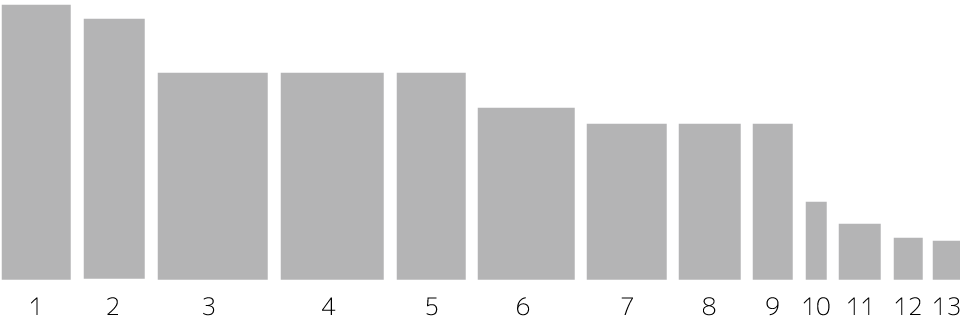
    I have summarized the representative paper sizes and their names in a table from largest to smallest. Please refer to the diagram below for reference.

    No. size Pronunciation cm(width×height) Different Names
    1 2×8尺 2×8 Shaku Approximately60×240cm 2×8(Nihachi)
    2 尺八屏 Shaku happei Approximately53×234cm Chinese Standard Size
          Approximately53×228cm Japanese Standard Size
    3 六尺画仙 Rokushaku gasen Approximately96×180cm 大画仙(Daigasen)
    4 3×6尺 3×6 Shaku Approximately90×180cm 三六(Saburoku)
    5 2×6尺 2×6 Shaku Approximately60×180cm 二六(Niroku)
    6 五尺画仙 Goshaku gasen Approximately84×150cm 中画仙
    7 四尺画仙 Yonshaku gasen Approximately69×136cm 全紙(Zenshi)・小画仙(Shougasen)・四尺物(Yonshakumono)
    8 聯落ち Renochi Approximately53×136cm ―
    9 半切 Hansetu Approximately34.5×136cm ―
    10 八つ切 Yatugiri Approximately17.5×68cm ―
    11 全懐紙 Zenkaishi Approximately36.5×48.5cm ―
    12 半懐紙 Hankaishi Approximately24.5×36.5cm ―
    13 半紙 Hanshi Approximately24.3×33.4cm ―

    Common Paper Sizes and Names

    “Yonshaku Gasen” (四尺画仙)

    Dimensions: Approximately 69 × 136 cm. It is also known by other names such as “Zenshi” (全紙), “Shōgasen” (小画仙), and “Yonshaku Mono” (四尺物).

    “Hansetsu” (半切)

    Dimensions: 34.5 × 136 cm. Hansetsu is created by vertically cutting “Yonshaku Gasen” (Zenshi) in half. Traditionally, it has been the most commonly used size.

    “Renochi” (聯落ち)

    Dimensions: 53 × 136 cm. It is a size obtained by cutting “Zenshi” into 3/4 of its original width. For a paper size of 53 × 228 cm, often used in open exhibitions and sometimes referred to as “Renochi,” it’s important to note that the term “Renochi” has come to refer more to the “width of the paper” due to decreased use of the traditional “true Renochi.” In this context, “Renochi” is roughly equivalent to “53 cm width,” and it’s essential to confirm the length.

    “Shaku happei” (尺八屏)

    This is a Chinese standard size with dimensions of approximately 53 × 234 cm. The Japanese standard size is approximately 53 × 228 cm. There is a difference of about 6 cm in length between the two standards, but both are widely used for open exhibitions.

    “Ni-Hachi” (2×8)

    “Ni-Hachi” typically refers to the frame size used in open exhibitions, which is 2 shaku × 8 shaku, approximately 61 × 242 cm. It’s important to note that the size of open exhibitions refers to the dimensions when framed. If you intend to display your work with a mat showing and use the “Ni-Hachi” frame size, choose a slightly smaller 53 × 228 cm (1.75 shaku × 7.5 shaku) paper. If you plan to fill the frame entirely with your artwork without showing the mat, select a 60 × 240 cm paper.

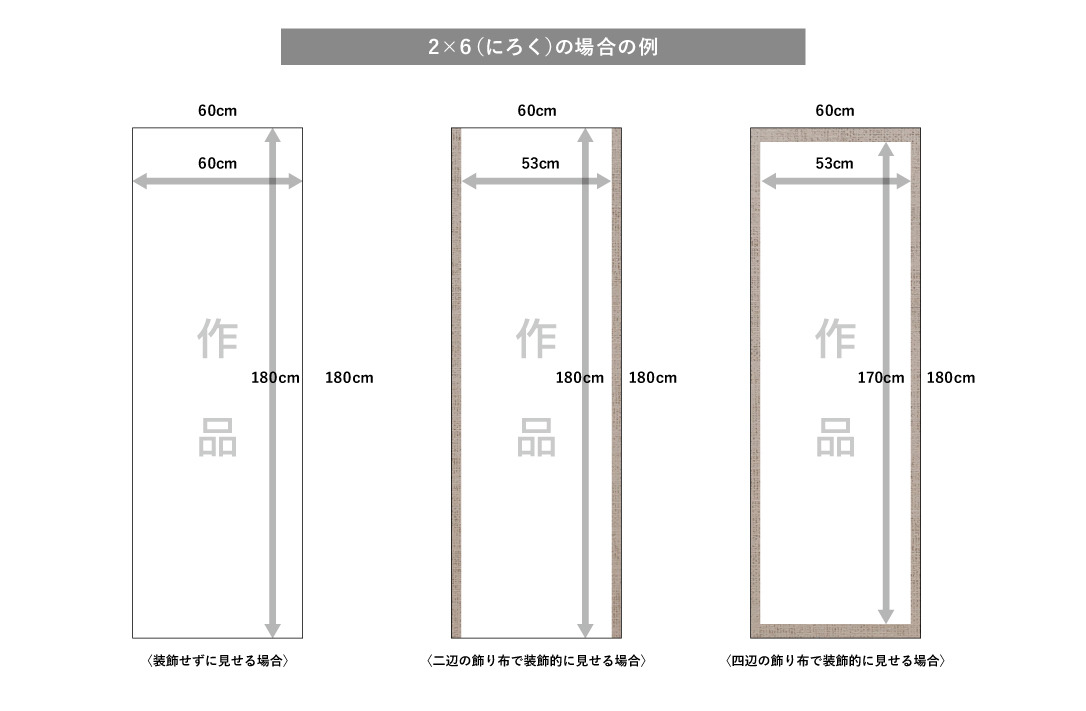
    “Ni-Roku” (2×6)

    “Ni-Roku” refers to the frame size used in open exhibitions, which is 2 shaku × 6 shaku, approximately 60 × 180 cm. Similar to “Ni-Hachi,” “Ni-Roku” refers to the frame size for open exhibitions. If you intend to display your work with a mat showing and use the “Ni-Roku” frame size, choose a slightly smaller 53 × 170 cm (1.75 shaku × 5.5 shaku) paper. If you plan to fill the frame entirely with your artwork without showing the mat, select a 60 × 180 cm paper.

    You can purchase paper available at Shogu Online here>>